We’ve put together three free Jeopardy templates for Google Slides that you can copy and start using right away. Whether you’re running a classroom review, a team-building session, or a game night, these templates are ready to go. Just swap in your own categories and questions.
Further down, we’ll also show you how to build your own Jeopardy template from scratch and how to customize the look and feel to match your style.
Table of Contents
Free Jeopardy Templates for Google Slides
All three templates open directly in Google Slides as an editable copy. No signup required, just click the button and a copy will be added to your Google Drive. Once you have your own copy, you can use them for math, history, general trivia, or whatever else you want to quiz people on. It’s your own Jeopardy game.
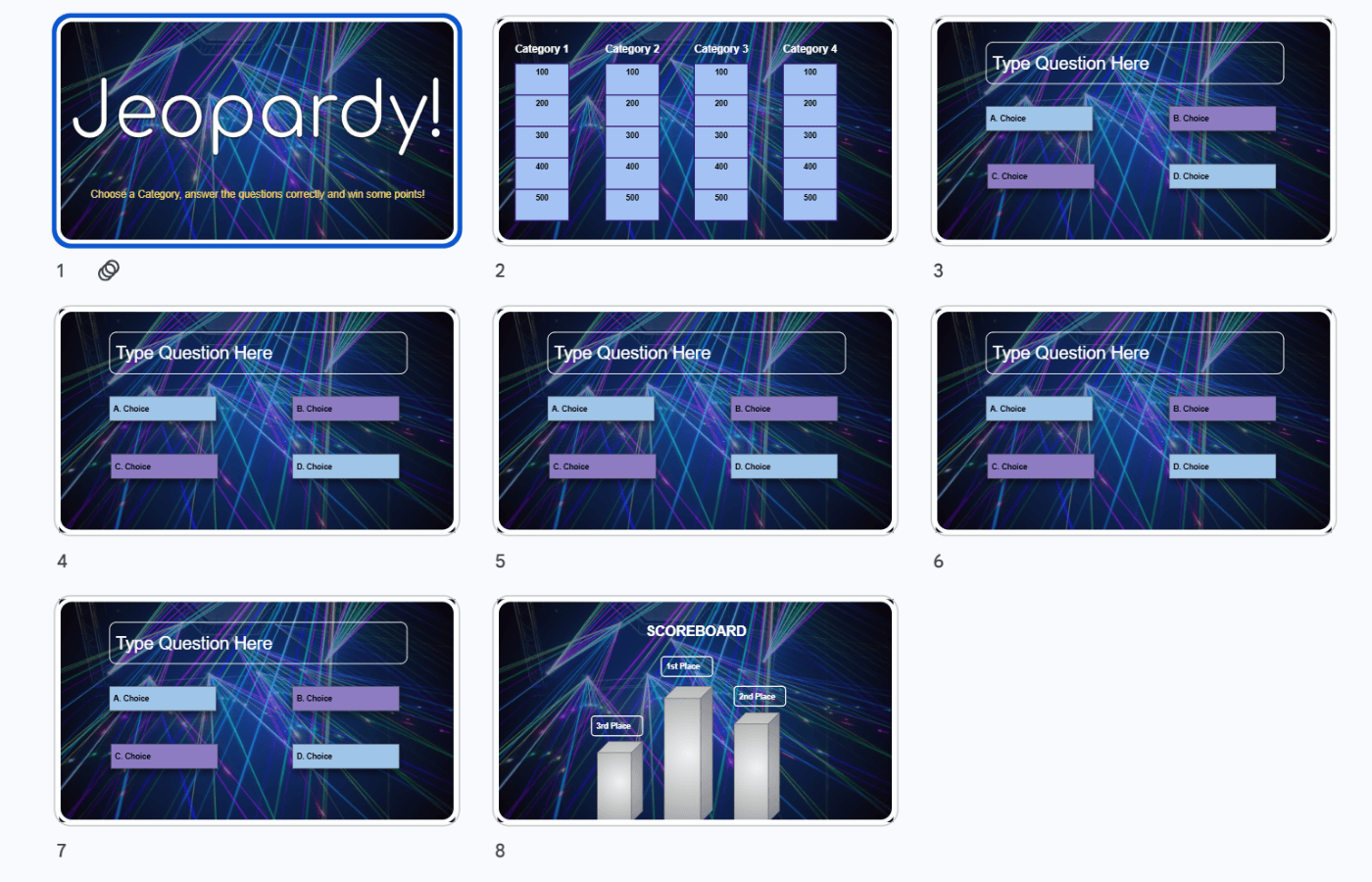
This template has the classic Jeopardy look. There are flashy colors, a clean game board, and everything you need to run a full game. It includes a title slide, category headers with point values, question slides with multiple choice options, and a scoreboard. Good for any subject or situation where you want the full Jeopardy experience. Just update with your own dollar amount options, or give a different point value system if you prefer. Update each of the categories with different subjects, then choose your questions (and answers). Your lucky contestants will love it.
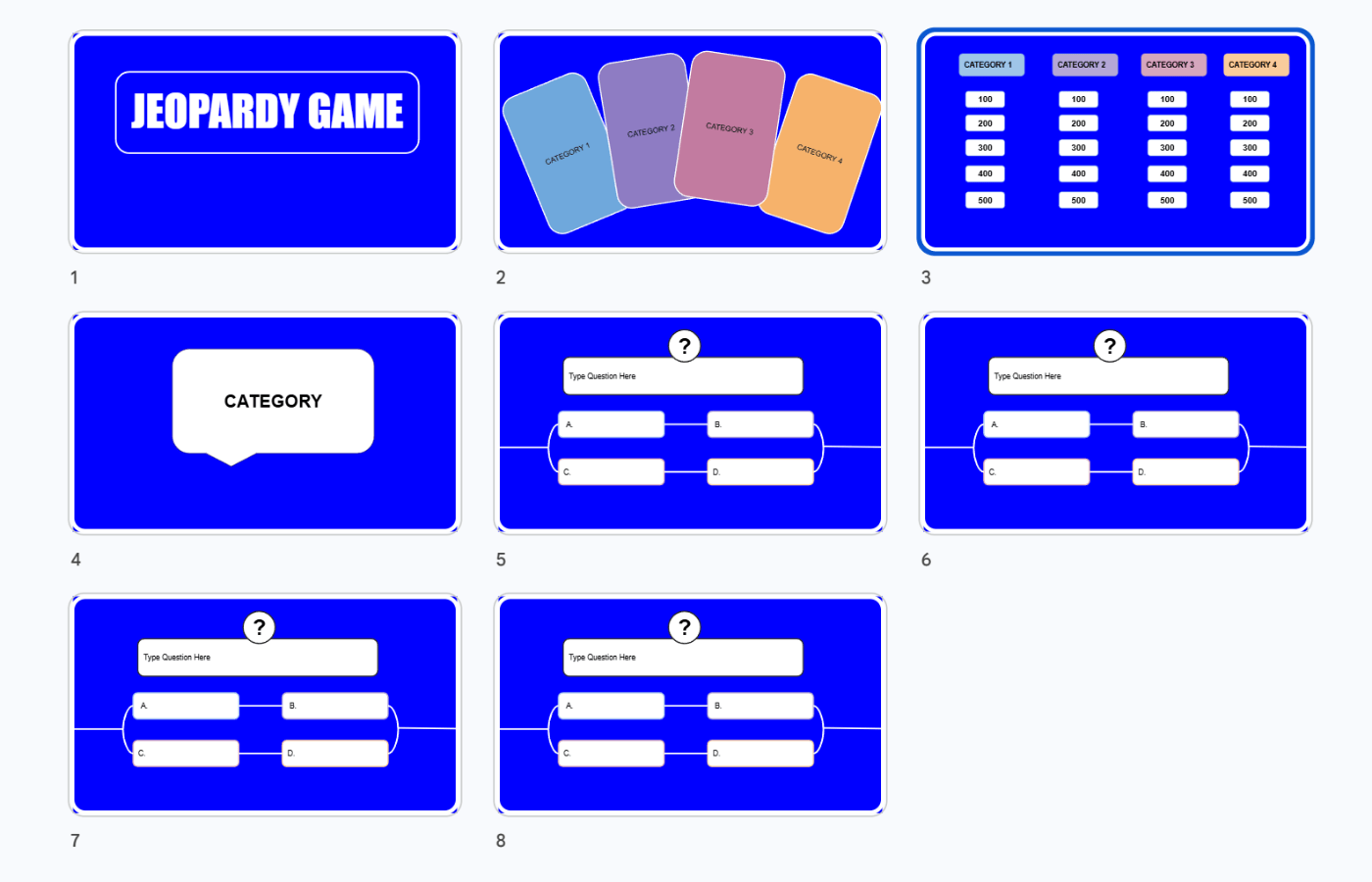
Fun and colorful, with traditional blue colors throughout. This one has four categories by default, but you can always add more. It includes a title slide, a category display slide, and question slides with multiple choice options. Works well for classroom review, team bonding, or a game night with friends and family. Once you answer one question, just move to the next slide by clicking the arrow button (in slideshow mode). I like this one because the subject slides can be made for each category. You can also add instructions or stick with the classic rectangles look.
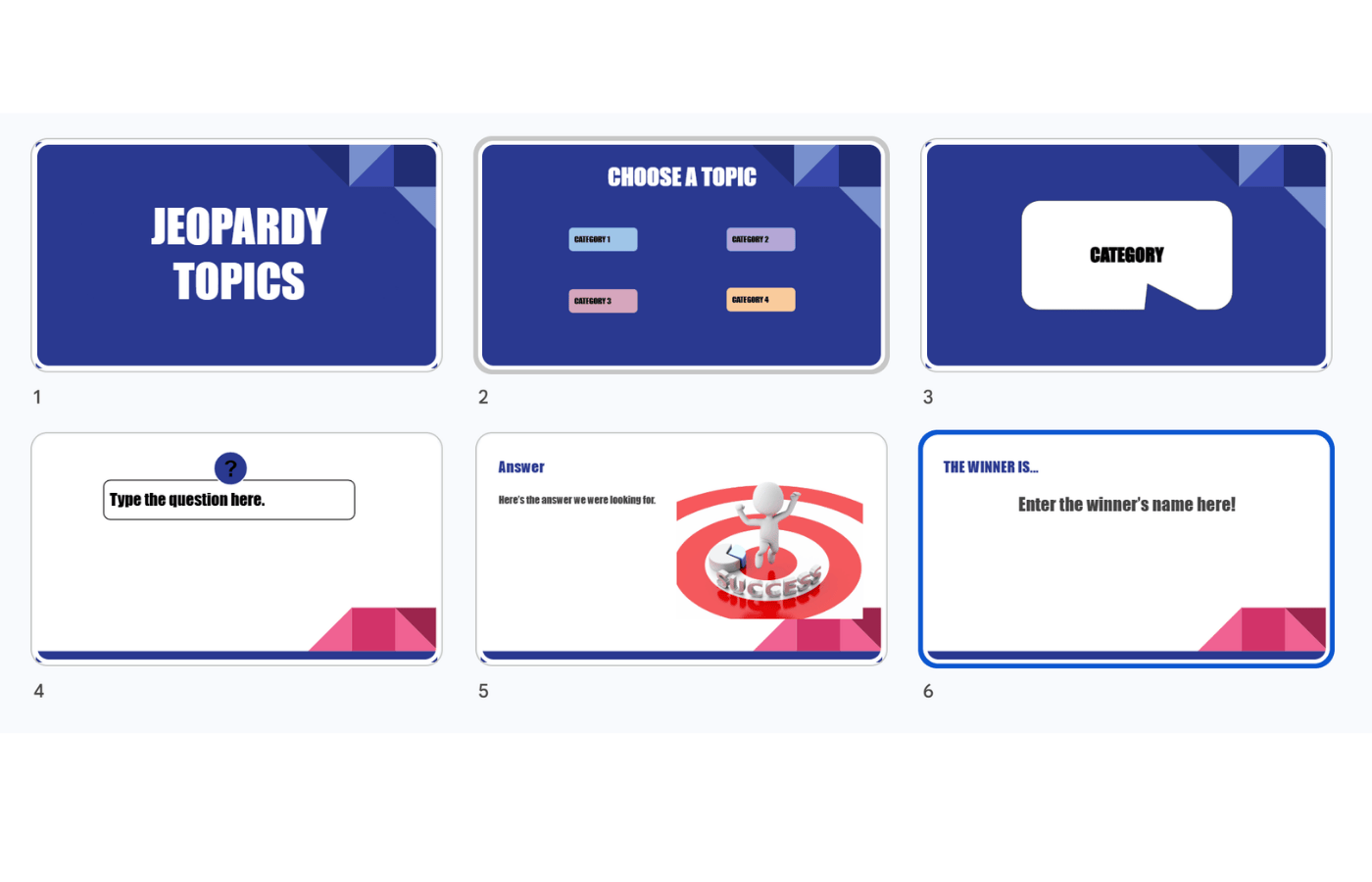
A slightly different format from the other two. Questions here don’t have multiple choices. Instead there’s a separate answer slide for each clue, with the option to include an image. You can also add a 5-second timer on each slide, which adds a nice sense of urgency. Key features include a title slide, rules for how to play, topics, question slides with point values, answer slides, and the built-in timer. The matrix on the topics page here is really simple. You can add as many as you want by duplicating any of the boxes on the page, then choosing a new color.
Since this template includes answer slides, you may want to hide those slides before sharing the file with students or players.
Tips for Running Jeopardy in Class
A few things that make the game run more smoothly, especially in a classroom setting:
Divide into teams before you open the slides. Three to four teams works well for a standard class size. Decide on a signal for answers, raised hands, a buzzer sound, or just pointing, and set that expectation before you start.
Keep score on a whiteboard or a separate tab. The templates don’t include live scoring. A whiteboard is the simplest option, or open a Google Sheets tab on a second screen and have a student volunteer keep track.
Set a rule for wrong answers before the game starts. Decide whether a wrong answer loses points, passes to the next team, or just moves on. Announcing the rule once at the start saves a lot of discussion mid-game.
Mark clues as used during the game. You can’t edit slides in Slideshow mode, so either briefly switch to Edit mode to grey out used buttons, or assign a student to manage the slides so you can focus on running the game.
Write clues as statements, not questions. In the real Jeopardy format, the clue is the answer and players supply the question. So instead of “What is the capital of France?”, the clue reads “This is the capital of France” and students respond “What is Paris?” It’s a small detail, but it makes the game feel more authentic and keeps students thinking in the right direction.
How to Create a Jeopardy Template in Google Slides
If you’d rather build your own Jeopardy template from scratch, here’s how to do it step by step:
Go to Google Slides.
Choose a background color or a theme. If you choose a background, make sure to click Add to theme to apply it to all your slides.
Type the title of your Jeopardy game on the first slide. You can also add a short description or a Start button.
Add a new slide by clicking the + sign or pressing Ctrl+M.
On the second slide, add your categories. Resize the text box and type your first category name.
Copy the text box and position the copies to create as many category columns as you need.
Go to Insert and add a table or text boxes for the point values under each category.
Resize the point value cells and enter the numbers (100, 200, 300, 400, 500 for a standard board).
Copy and paste the point value column for each remaining category. Format the text however you like font, size, color.
Add a new slide for each clue. Type the clue text. Write it as a statement rather than a question, in the classic Jeopardy format. If you want multiple choice options, add a shape for each one.
Copy and paste the choice boxes to add the remaining answer options.
Format the choice boxes however you like with colors, borders, font size.
Once you’re happy with the clue slide, duplicate it for each remaining question.
That covers the basic structure. Once all your clue slides are in place, link each point value button on the board to the correct slide. Right-click a button, choose Link, and select the corresponding slide number. Test everything in Slideshow mode before class.
You can also insert a Google Sheets scoreboard directly into your presentation if you want live score tracking built into the same file.
Editing Your Jeopardy Template
Once you’ve got the structure in place, here are a few ways to customize the look and feel:
Background
You have a couple of options beyond a plain solid color:
Pick a preset gradient or create your own by clicking the + sign for Custom.
In Custom mode, choose your colors and adjust the angle and stop positions.
Click Add to theme when you’re done to apply the background to all slides at once.
An image: You can also use an image as your background for a more dynamic look:
Go to Background.
Click Choose Image.
Go to Upload and click Browse, or navigate to where your image is stored.
Select your image and click Done.
Keep in mind that a background image set this way can’t be resized or repositioned. If you need more control over the image, insert it via the Insert > Image menu instead, then resize and reposition it as needed.
Font
Google Slides gives you a good range of font options to work with:
Font: Select any text and use the font drop-down in the toolbar to change it. If the default options aren’t enough, click More fonts to browse the full library.
Font size: Click the + or – buttons next to the size field, or click the size number directly and type a new value.
Font color: Use the font color button in the toolbar to choose from the default palette or create a custom color.
Word Art: For more stylized text with gradients, shadows, or reflections, use Word Art. Go to Insert > Word Art, type your text, and press Enter. Click on the word art element and choose Format options in the toolbar to access the full range of effects.
Buttons
You can use shapes as clickable buttons for your point values. Find the shape tool in the toolbar, choose a shape, and draw it on the slide. You can format it just like any other element: resize, reposition, change fill and border colors, and even apply gradients.
To add text inside a shape, double-click it and start typing. This is how you add point values or answer choices directly onto a button. To link a button to a specific clue slide, right-click it, select Link, and choose the slide you want it to navigate to.
You can make your slides look even more professional by experimenting with Google Slides design tips, things like consistent fonts, aligned elements, and intentional color use go a long way.
Frequently Asked Questions
Can I use these Jeopardy templates for free?
Yes. All three templates are free to copy and use. Click any download button and Google Slides will create an editable copy in your Google Drive. You’ll need a standard Google account.
Do the templates work on a projector or interactive whiteboard?
Yes. Present the file in Slideshow mode and it will display full-screen on a projector or smartboard. The clickable point buttons work the same way in presentation mode as they do in edit mode.
Can I download the template as a PowerPoint file?
Yes. Go to File > Download > Microsoft PowerPoint (.pptx) and Google Slides will export a .pptx version you can open in PowerPoint. The layout and formatting carry over, though some interactive slide links may need to be checked after the conversion.
How do I add more categories to a template?
Duplicate an existing category column on the game board, update the category name, then add the corresponding clue slides and link the new point buttons to them. Resize the board columns as needed so everything fits on screen.
How do I share the Jeopardy game with students?
For a live class game, connect your device to a projector and run it yourself. Students shouldn’t have edit access during a live game or they’ll be able to navigate the slides on their own. If you want students to play independently, share the file with Viewer access and set it to open in Slideshow mode.
Can I add sound effects to the template?
Yes. Go to Insert > Audio and upload an MP3 from your Google Drive. You can set it to play automatically when a slide opens. The Jeopardy think music is widely available for personal and educational use.
What’s the best team size for classroom Jeopardy?
Three to four teams of five to seven students tends to work well for a class of 25 to 30. Smaller teams mean more students engage with each clue. Larger teams make it easier for students to sit back and let others answer.
Thanks for visiting! We’re happy to answer your spreadsheet questions. We specialize in formulas for Google Sheets, our own spreadsheet templates, and time-saving Excel tips.