
Couples usually build the guest list first. Then they start looking at venues. That order costs money.
The moment you attach a real venue to a real guest count, the math gets complicated fast. Venue minimums, catering tiers, and staffing ratios all create breakpoints where adding 20 more people to the list costs significantly more than 20 people’s worth. Understanding where those breakpoints are before you finalize the list is the move most couples don’t make until it’s too late.
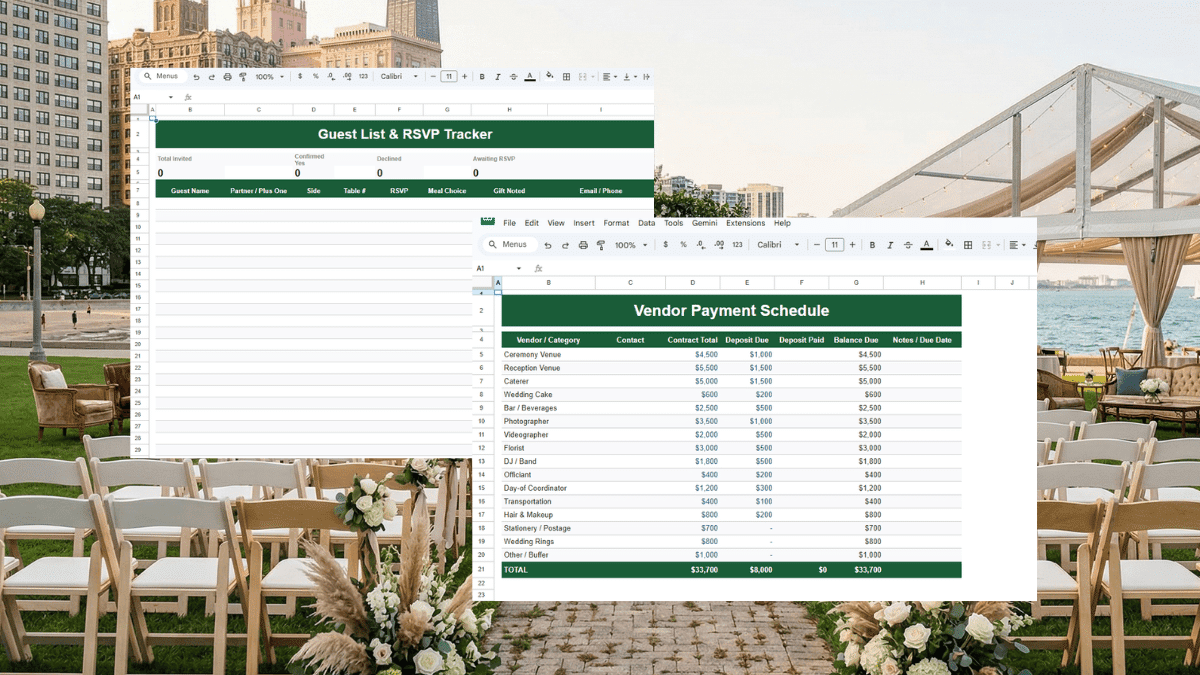
This article breaks down how wedding costs actually scale with guest count, where the non-linear jumps happen, and how to run the math for your specific situation. If you want to track all of it in one place, the wedding planning spreadsheet gives you a ready-built framework to plug your numbers into.
Fixed wedding costs that don’t move regardless of how many people you invite
Before you can understand per-head costs, you need to isolate the costs that have nothing to do with guest count. These stay flat whether you invite 50 people or 200.
Fixed costs typically include venue rental (the room fee, separate from food and beverage minimums), photography and videography, ceremony officiant, DJ or band, florals for the ceremony and head table, and the wedding cake base price. For most weddings, this fixed layer runs $8,000 to $18,000 depending on market and vendor tier.
Most couples don’t separate fixed from variable costs when they’re budgeting. Everything gets lumped into a total number, which makes it nearly impossible to model what happens when the guest list grows. The first thing worth doing in any wedding budget spreadsheet is splitting these two categories into separate rows.
Per-head costs that scale directly with guest count
Once the fixed layer is set, everything else moves with the guest count. Catering is the largest variable: plated dinners typically run $85 to $175 per person depending on region and service style, with buffets landing at the lower end and multi-course plated service at the higher end. Bar packages add another $45 to $85 per person on top of food.
Rentals scale proportionally too. Chairs, linens, place settings, and glassware are priced per unit. Favors, printed menus, and escort cards are per person. If you’re sending physical invitations with RSVP cards and postage, add $3 to $8 per household to the count.
A conservative per-head variable cost for a mid-range wedding (food, bar, and rentals) lands around $150 to $200 per guest in most US markets. That number climbs in major metros. It drops in smaller cities and rural venues, but not as dramatically as couples often expect.
The breakpoints where costs jump more than the math suggests they should
Guest count increases don’t produce a smooth cost curve. They produce a staircase, and most couples don’t see it coming.
The jumps happen because venue capacity tiers are discrete, not continuous. A venue that holds 75 guests comfortably is a different venue than one that holds 125. When your guest list grows from 80 to 90, you’re not just adding 10 people’s worth of catering. You’re potentially moving into an entirely different venue category with a higher rental fee and a higher food and beverage minimum.
Catering minimums create a similar effect. Many venues require a minimum spend on food and beverage regardless of guest count. If that minimum is $12,000 and you’re having 60 guests, you’re spending $200 per head on catering whether you want to or not. At 80 guests, the same minimum costs $150 per head. At 100 guests, $120. The per-head cost actually drops as you add guests, up to the point where the minimum resets at the next tier.
Staffing ratios add another layer. Most caterers run one server per 8 to 10 guests. When your count crosses a threshold that requires an additional server, that cost is fixed regardless of whether you’re at 81 guests or 89. Bar staffing works the same way.
What the numbers look like at 50, 100, and 150 guests
The table below models costs using a mid-range variable rate of $175 per head (food, bar, and rentals) and fixed costs held constant at $12,000. For context, The Knot’s 2026 Real Weddings Study surveyed more than 10,000 couples married in 2025 and found they spent an average of $292 per guest all-in, including fixed costs spread across 117 guests. The model below sits below that average, making it a reasonable baseline for planning purposes before you have real vendor quotes.
| Guest Count | Fixed Costs | Variable Costs | Total | Cost Per Guest |
|---|---|---|---|---|
| 50 guests | $12,000 | $8,750 | $20,750 | $415 |
| 100 guests | $12,000 | $17,500 | $29,500 | $295 |
| 150 guests | $12,000 | $26,250 | $38,250 | $255 |
The cost-per-guest number drops as the list grows because fixed costs spread across more people. A 50-person wedding costs $415 per guest in this model. A 150-person wedding costs $255. That pattern leads some couples to rationalize a larger guest list as more economical, and it can be, but only if the venue tier doesn’t change. Once you cross into a larger venue with a higher minimum, the fixed cost layer resets upward and the math changes entirely.
The wedding planning spreadsheet lets you plug in your actual venue’s fixed costs and per-head rates to run these scenarios for your specific situation rather than modeled averages.
How much does a 100 person wedding cost?
Based on our data, we expect a 100 person wedding to cost between $12,000 and $29,500. The prices vary based on location, catering, and entertainment options. A spreadsheet will help quickly calculate an estimated cost for your specific event.
How much does a 50 person wedding cost?
Based on our data, we expect a 50 person wedding to cost between $8,750 and $20,750. As with weddings of any size, these prices differ depend on location, catering, etc. We use spreadsheets to calculate expenses much more accurately when planning events.
What’s the average cost per wedding guest?
According to our research, couples married in the past year spent an average of $292 per guest all-in, with an average total wedding cost of $34,000 across 117 guests. Variable costs alone (catering, bar, and rentals) typically run $150 to $200 per head in most US markets, with the remainder covering fixed costs spread across the guest count.
How to use this math to make the actual decision
Start with the venue tier, not the guest list. Pick a budget ceiling first. Identify venues that fit within that ceiling for the guest count you’re considering. Get the actual food and beverage minimum and per-head catering rate from each venue. Then build the guest list around those numbers rather than the other way around.
The practical sequence: set a total budget, subtract your fixed costs to get your variable budget, divide by your per-head rate to get your maximum guest count. That number tells you exactly how many people the budget supports before you invite anyone.
If the resulting guest count is lower than your initial list, you have two options. Cut the list to fit the budget, or find a venue with a lower per-head minimum. Running both scenarios in a spreadsheet before making calls to venues saves a significant amount of back-and-forth. A wedding guest list template helps you work through prioritization once you have a firm number to work with.
Regional cost differences that change the baseline
The scenarios above use national averages. Regional variation is significant enough to matter when you’re doing your own modeling.
Catering costs per head in New York and San Francisco typically run 40 to 60 percent above the national average. Chicago, Boston, and Los Angeles run 20 to 35 percent above. Mid-size cities like Nashville, Denver, and Austin sit close to the national average. Smaller markets and rural venues often run 15 to 25 percent below.
The fixed cost layer varies less by region than catering does. Photography and DJ rates in major metros are higher, but not proportionally so. Venue rental fees can swing dramatically within a single city depending on neighborhood and day of week. Friday and Sunday weddings at the same venue typically run 20 to 30 percent less than Saturday.
The costs worth cutting first if the guest count won’t budge
If the math doesn’t work and the list is non-negotiable, the cuts that hurt the least come from the fixed layer rather than the per-head layer. Scaled-back florals and a DJ instead of a band each reduce the fixed cost total without changing the per-head number. A dessert bar instead of a tiered cake does the same.
Buffet service instead of plated can drop the per-head catering cost by $30 to $50 without a visible drop in food quality. Beer and wine only instead of a full bar saves another $20 to $35 per head. Those two changes on a 120-person wedding can recover $6,000 to $10,000 of budget without touching the guest list.
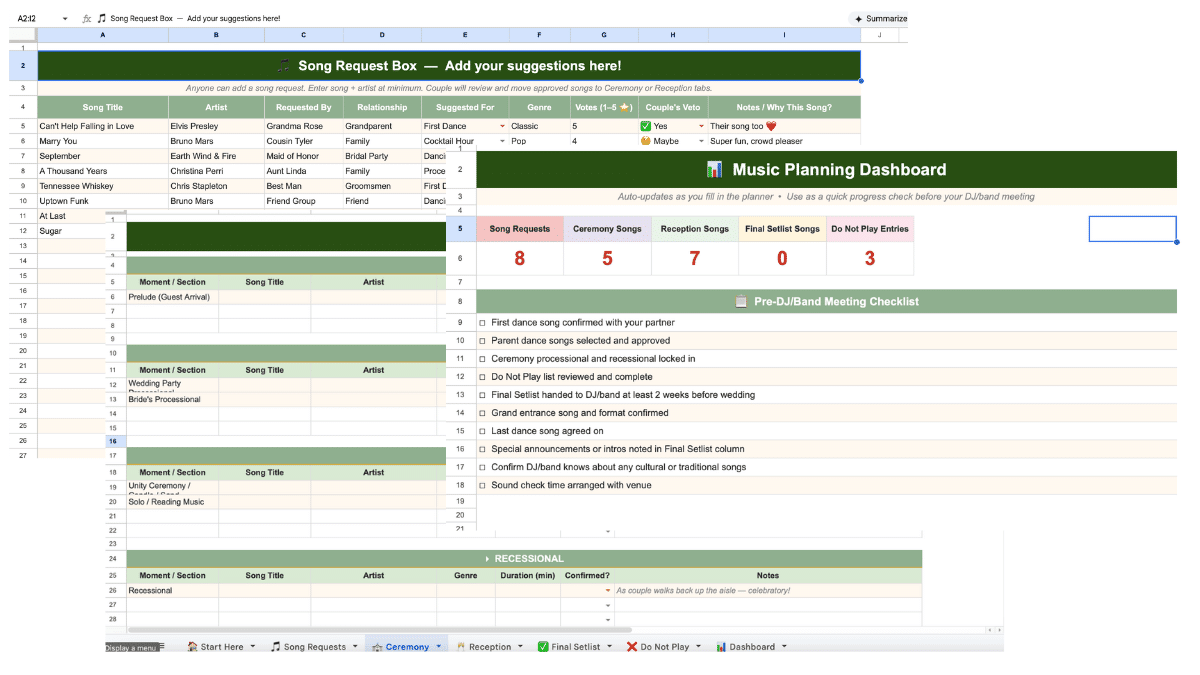
Tracking these trade-offs side by side in a spreadsheet makes the decision clearer. The wedding planning spreadsheet has a budget section built for exactly this kind of scenario comparison.
Is it cheaper per person to have a bigger wedding?
Often yes, up to a point. Fixed costs spread across more guests lower the per-head total. A 50-person wedding can cost $150 or more per head than a 150-person wedding at the same venue. The math reverses when a larger guest count pushes you into a higher venue tier with a higher rental fee and food and beverage minimum.
What is a reasonable catering budget per head?
Buffet service in most US markets runs $85 to $120 per person. Plated dinners run $120 to $175. Full-service plated with multiple courses in a major metro can reach $200 or more. These figures typically exclude bar service, which adds $45 to $85 per person.
How do I figure out how many guests I can afford?
Start with your total budget. Subtract fixed costs (venue rental, photography, DJ, florals, cake). Divide the remaining amount by your per-head variable rate (catering plus bar plus rentals). The result is your maximum guest count. Running this in a spreadsheet lets you test different per-head rates and fixed cost combinations before committing to a venue.
What costs should I cut first if the guest count is too high?
Start with the fixed cost layer: florals, entertainment, and cake. Switching from a band to a DJ, simplifying ceremony florals, and replacing a tiered cake with a dessert table can recover $3,000 to $6,000 without affecting the per-head count. If more is needed, buffet service instead of plated and beer-and-wine-only bar packages are the highest-value per-head reductions.
Do venue minimums include catering?
Usually yes, but confirm directly. Most venue food and beverage minimums count toward catering costs, meaning you’re not paying the minimum on top of catering. You’re committing to spend at least that amount on food and beverage. If your guest count naturally hits that spend, the minimum becomes irrelevant. If it doesn’t, you’re paying for it regardless.