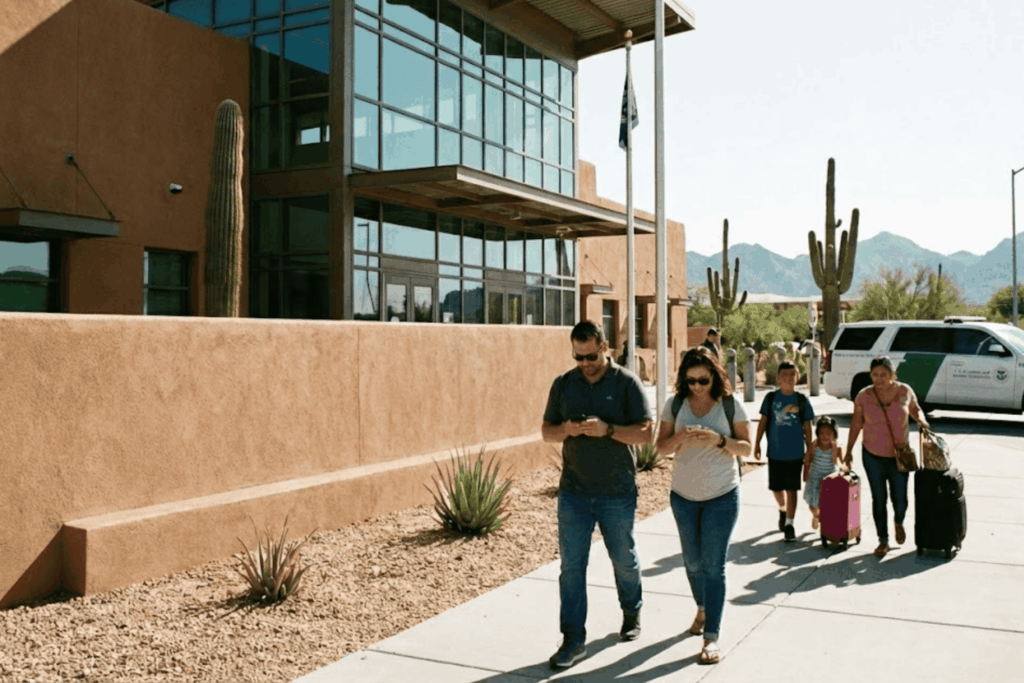
Customs and Border Protection proposes requiring visitors to submit five years of social media history, emails, and family details as part of entry screening.
The US Customs and Border Protection agency has unveiled plans that would fundamentally reshape how international tourists enter the country. Under the proposal, all visitors would be required to submit their social media profiles from the past five years before crossing the border. The mandate, published in the Federal Register as part of a broader information collection update for the I–94 and ESTA systems, is now open for public consultation for 60 days. It represents a significant expansion of the data collection already required through the ESTA electronic travel authorization system.
Beyond social media, the proposed screening would demand email addresses, phone numbers, and detailed family information like names, addresses, and birthdates of relatives. The list runs long: phone numbers used in the last five years, email addresses used in the last ten, IP addresses and metadata from electronically submitted photos, family members’ names and contact details, and business contact information tied to the traveler’s work history. The agency also wants to collect and link more biometric data such as facial recognition, fingerprints, DNA, and iris scans as part of the application process.
Those ambitions sit on top of a separate pilot that would let travelers use the CBP Home mobile app to voluntarily report their exit from the United States. Under the Voluntary Self-Reported Exit program, travelers subject to I–94 requirements could use their phones to submit passport details, a live selfie, and their location after they leave the country, creating a biometrically confirmed exit record to close the loop on their last arrival. CBP argues this will tighten its entry–exit tracking and give travelers proof that they complied with the terms of their stay.
At the same time, CBP is moving the ESTA system onto a smartphone-centric footing. The notice explains that the traditional ESTA website will be decommissioned as an application portal, with the mobile app becoming the only way to submit a new ESTA application. Officials say poor-quality photos and fraudulent third-party websites have undermined identity checks on the web, so they want to rely on the app’s live image capture, passport chip scanning, and liveness detection to verify that the person applying is the actual passport holder.
Now, CBP’s own paperwork shows just how many people could be touched by the new approach: the agency expects more than 14.4 million ESTA mobile applications a year, with each one taking roughly 22 minutes to complete, plus millions of I–94 and CBP Home interactions layered on top of that.
Observers and commenters have expressed significant concern about the proposal, viewing it as a troubling erosion of civil liberties and a potential blow to America’s global reputation. The community reaction has centered on worries about xenophobia, constitutional rights, and the practical impact on tourism and the economy. For visitors from key markets like the United Kingdom, Germany, Brazil, South Korea, and India, the message is clear: a simple holiday flight now comes with a far more intrusive digital background check and a strong nudge to manage every interaction with US border authorities through a mobile app.
The proposal arrives amid a broader pattern of tension surrounding free speech issues under the current administration. Recent months have seen high-profile clashes, including the temporary suspension of talk show host Jimmy Kimmel over critical comments and a federal judge’s ruling that the administration’s freeze of research funding to Harvard was unconstitutional and retaliatory. These incidents have fueled public skepticism about the government’s approach to expression and oversight, even as officials defend enhanced security measures as necessary for border protection. And international travelers can expect more policy changes in the future, as CBP openly signals that mobile apps, expanded biometrics, and “high value” data harvesting are the new template for screening.
| Rank | Country (overseas market) | Estimated visitors to the U.S., 2024 YTD* | Notes |
|---|---|---|---|
| 1 | United Kingdom | 2,195,090 | Largest overseas source market in Jan–July 2024, up about 4.5% vs 2023. |
| 2 | India | 1,313,758 | Fast-growing market, up about 35.1% vs 2023 and already above 2019 levels. |
| 3 | Germany | 1,080,044 | Major European market, up about 12.6% vs 2023. |
| 4 | Brazil | 1,063,607 | Largest South American source market in the top 10, up about 24.4% vs 2023. |
| 5 | South Korea | 996,777 | Key Asia-Pacific market, up about 14.0% vs 2023. |
*Visitors are non-U.S. residents arriving from overseas by air, year-to-date January–July 2024; final full-year 2024 totals will be higher but follow a similar ranking.
Source: National Travel and Tourism Office (NTTO) / Brand USA year-to-date visitation update for January–July 2024.
The 60-day consultation period will likely become a flashpoint for debate about the balance between national security and personal privacy. Travel groups, civil liberties advocates, and local officials can already sketch out the stakes with simple spreadsheets: a basic travel or security budget template can show how stricter screening, longer wait times, and higher denial rates might hit local economies. Using CBP’s own burden estimates, it is easy to plug in 14.5 million ESTA mobile applications at 22 minutes each and see how quickly the paperwork hours add up.
For those comfortable with formulas, scraping websites using Google Sheets makes it easier to pull tourism data, public comments, and future Federal Register notices into a spreadsheet and separate political rhetoric from what the numbers actually say about how aggressively the US intends to monitor international visitors.