
As electric vehicle sales underperform lofty forecasts, Toyota is doubling down on hybrid technology with a massive battery plant investment in North Carolina.
Toyota, the automaker that long resisted the industry’s push toward all-electric vehicles, is making one of its boldest moves yet. The Japanese giant announced a $14 billion investment to expand battery production in the United States, with a sprawling new facility between Greensboro and Raleigh, North Carolina.
The batteries produced there will power hybrids assembled in Kentucky and Alabama. And that’s a clear signal that Toyota believes the future of American transportation may not be purely electric after all.
Recent sales data helps explain the bet. In 2022, Americans bought roughly 754,722 hybrid vehicles and about 713,000 pure EVs. By 2023, hybrid sales had surged to around 1,242,608 while EVs climbed to about 1,000,000. In 2024, hybrids pulled further ahead, reaching an estimated 1,513,000 sales compared with roughly 1,200,000 electric vehicles.
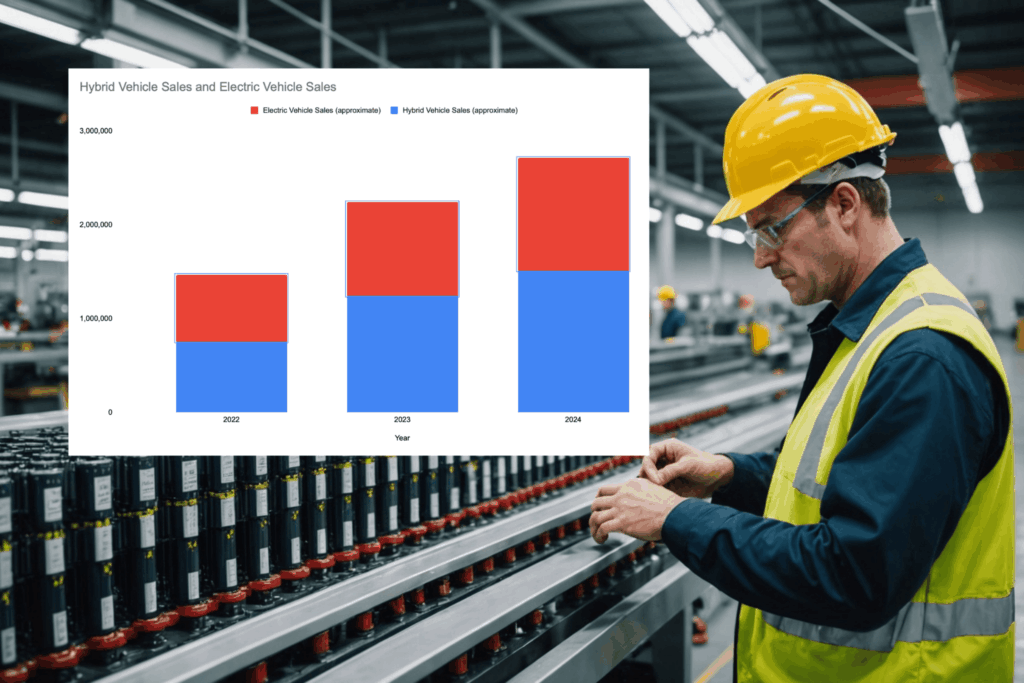
The overall picture shows hybrid vehicle growth surging as a practical choice for many buyers. And that comes at a time when, despite the removal of tax incentives, EV sales continue to set new records.
| Year | Hybrid vehicle sales (approx.) | Electric vehicle sales (approx.) |
|---|---|---|
| 2022 | 754,722 | 713,000 |
| 2023 | 1,242,608 | 1,000,000 |
| 2024 | 1,513,000 | 1,200,000 |
These figures are based on data compiled by Edmunds, which tracks hybrid, plug-in hybrid, and EV sales trends each year. Edmunds’ EV and hybrid sales overview provides the underlying totals.
The timing of this investment speaks volumes about the current state of the EV market. For years, Toyota held firm while competitors retrofitted factories and launched all-electric models in preparation for a rapid shift away from gasoline.
Now, as federal tax credits change, charging infrastructure continues to roll out unevenly, and EV adoption softens relative to bullish forecasts, Toyota’s patience looks more calculated than timid. The company is betting that American consumers, many of whom remain hesitant about full electric vehicles, will increasingly embrace hybrids that deliver much better fuel efficiency than traditional gas-powered cars while still relying on the familiar gas station network. Toyota also plans to invest up to $10 billion in additional U.S. manufacturing over the next five years.
For analysts and everyday drivers who want to dig into the numbers themselves, it is easy to drop annual hybrid and EV sales into a simple spreadsheet and calculate growth rates, market shares, and long-term trends. In Google Sheets, you can use formulas like those in this IMPORTXML tutorial for Google Sheets to pull updated sales data directly from the web into a live dashboard that refreshes over time.
If you prefer working in Excel, it only takes a few formulas to compute year-over-year growth and visualize whether hybrids are pulling away from EVs. This guide on calculating year over year growth in Excel walks through the process of turning a simple three-row table into a trend analysis.
Toyota’s $14 billion wager reflects a fundamental truth about the American consumer: the transition to cleaner transportation is happening, but not necessarily in the way many predicted. Hybrids may represent a more pragmatic middle ground than the industry initially acknowledged, offering significant emissions reductions without requiring drivers to completely reimagine how they fuel, plan trips, or maintain their vehicles.
At the same time, EVs are building a larger base every year. The real story in the sales data is the rise of a two-track transition, with hybrids and EVs expanding together rather than one cleanly replacing the other.