The Kremlin welcomed the new U.S. national security strategy, calling it largely aligned with Moscow’s views. The rare public agreement has triggered concern about American commitment to traditional alliances.
In a striking moment of diplomatic convergence, the Kremlin on Sunday praised President Trump’s newly unveiled national security strategy, marking perhaps the most fulsome public endorsement Moscow has offered a U.S. security document since the Cold War ended. Kremlin spokesman Dmitry Peskov told state television that the adjustments outlined in the new approach correspond in many ways to Russia’s view, particularly welcoming language about limiting NATO’s expansion and a stated U.S. interest in negotiating an end to the war in Ukraine.
The strategy itself reflects a significant reorientation of American foreign policy priorities. Beyond the Russia overture, it invokes a 19th-century Monroe Doctrine framing the Western Hemisphere as a U.S. zone of influence, warns that Europe faces the prospect of civilizational erasure, and signals a pivot toward the Indo-Pacific as the primary geopolitical battleground, with China and Taiwan at the center. For Russia, which has increasingly aligned itself with China following Western sanctions over Ukraine, the shift in American strategic focus appears to create diplomatic space previously unavailable.
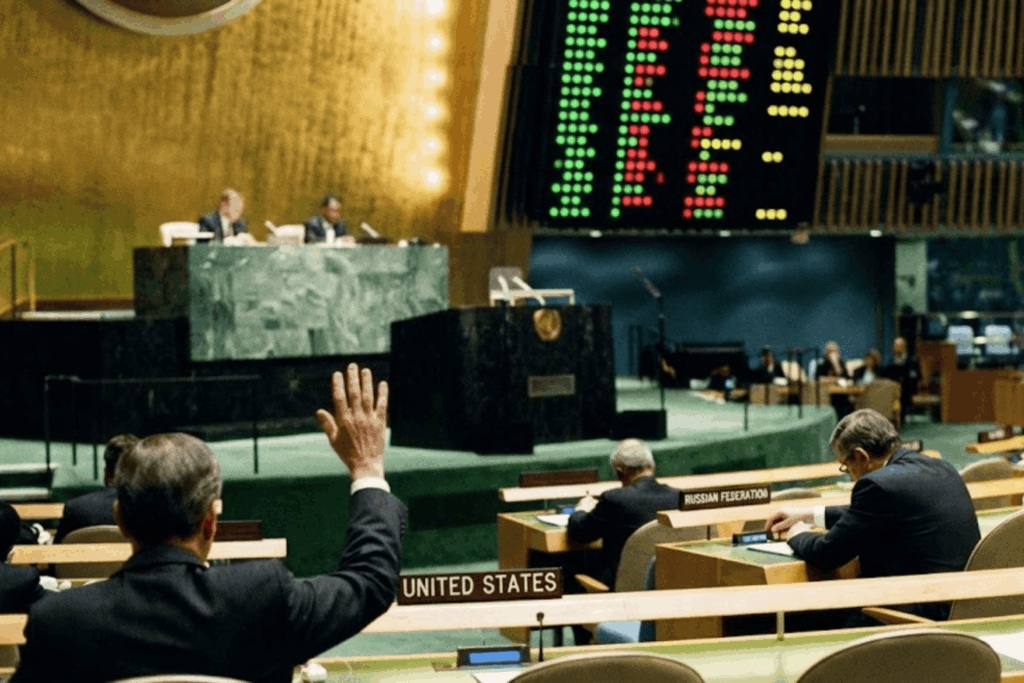
Headlines about Kremlin praise can make it sound like Washington and Moscow are moving into a period of broad strategic harmony. The voting record at the United Nations tells a different story. U.S. State Department data on General Assembly roll call votes shows that the two governments rarely end up on the same side of the ledger.
Here is a simplified view of how often U.S. and Russian votes lined up at the UN General Assembly in recent years. Note that these numbers are from the U.S.-designated important votes.
| Year | U.S.–Russia Voting Coincidence |
|---|---|
| 2019 | 23% |
| 2020 | 19% |
| 2021 | 28% |
| 2022 | 21% |
| 2023 | 6% |
| 2024 | 3% |
On average, that means Russia backed the U.S. position on less than a quarter Washington’s list of especially important votes. These figures draw on the State Department’s annual Voting Practices in the United Nations report, which breaks down how often Washington and other governments vote together in the General Assembly.
The pattern undercuts the idea of a deep realignment. There may be occasional moments of rhetorical or tactical agreement, but the default setting in New York is still disagreement. And this is happening while Canadian flights to the U.S. are falling every month.
Many observers worry that the U.S. is retreating from its post-Cold War role as guarantor of European security, with some framing the alignment as evidence of a fundamental shift that could reshape global power dynamics. The numbers above place those fears in context. Even in the best year on the chart, the two governments voted together less than 35 percent of the time in the General Assembly.
Historians and analysts note that such public agreement between Washington and Moscow on matters of global strategy is genuinely rare. During the Cold War, the two superpowers traded ideological barbs, with Ronald Reagan famously calling the Soviet Union an “evil empire”. Even after the Soviet collapse, tensions mounted as NATO expanded eastward, a process that Moscow has long resented.
The current moment certainly looks like a departure from decades of adversarial positioning, though skeptics caution that Peskov himself hedged his remarks by suggesting that long-term policy elites in Washington might view matters differently than Trump. Set against the UN voting record, and the specific points highlighted in initial Reuters coverage of the strategy, it reads less like a historic turn and more like a sharp, but narrow, episode in a long-running rivalry.
What emerges from this convergence is a fundamental question about the future architecture of global security, one that benefits from more than clips and headlines. A basic spreadsheet with a few years of UN voting data can cool off an inflammatory narrative and show whether talk of alignment reflects a structural shift or a momentary overlap.
If you want to go further, you can pull roll call data into Google Sheets, calculate voting coincidence, then drop the results into a simple dashboard based on our Google Sheets dashboard template. Whether this represents a genuine strategic realignment or a temporary diplomatic gesture remains unclear, but the numbers suggest that for now, at least, U.S. and Russian positions remain far apart on most of the concrete decisions that pass through the General Assembly.